The Transmission Problem: Why We Invested in Tangible to Orchestrate the Hard Asset Supercycle
At Aperture, our investment thesis is predicated on a shift in the tectonic plates of the global economy. We believe we are transitioning from the “Installation” phase of the digital revolution—dominated by software, asset-light models, and financial capital—to the “Deployment” phase. In this new era, technology must integrate with the physical world to solve existential challenges in energy, defence, and manufacturing.
This is the dawn of the Hard Asset Supercycle.
However, as we survey the landscape of funding for this supercycle, we see a critical breakage point. It is not a lack of innovation: engineers are building incredible things. Nor is it strictly a lack of global capital: trillions sit in institutional funds. The failure point is a transmission problem. The pipe connecting the world’s deepest capital pools to its most vital physical assets is broken.
We are investing in Tangible because they are building the new financial rails to fix this transmission problem, bridging the gap between the ‘Mars’ of Venture Capital and the ‘Venus’ of Private Credit.
The $68 Trillion Challenge
To understand the scale of the opportunity, one must look at the infrastructure gap. As BlackRock Chairman Larry Fink highlighted, the global demand for new infrastructure investment by 2040 will reach $68 trillion.
To put that figure in perspective,, it is roughly the equivalent of rebuilding the entire US Interstate Highway System and the Transcontinental Railroad, from start to finish, every six weeks for the next 15 years!
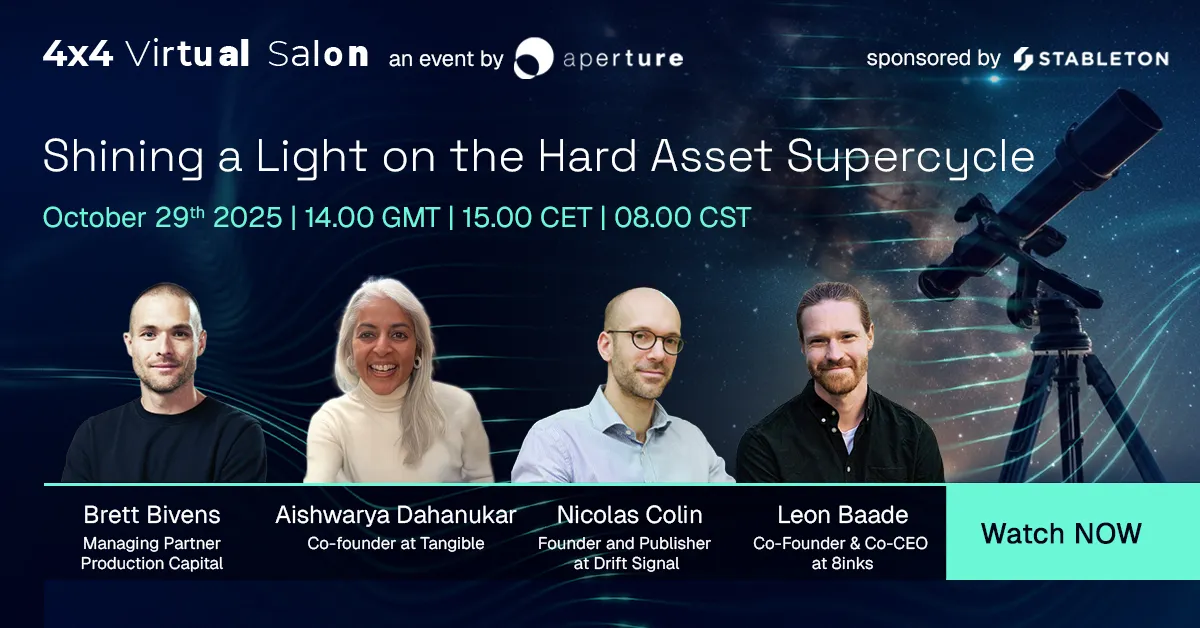
For the past decade, the dominant narrative was that “software is eating the world”. While true, software has reached a point of diminishing returns in isolation. As Nicolas Colin put it in our recent 4 x 4 Virtual Salon discussion, to disrupt tangible industries like automotive, logistics, and power generation, software needs “digestive pills”—it needs hard assets to facilitate that disruption. The next generation of innovative ventures will not just move bits; they will move atoms. They will be “New Industrials” rather than just software vendors.
The Valley of Death: Mars vs. Venus
The bottleneck preventing this $68 trillion deployment is the cultural and structural divide between two forms of capital: Venture Capital (Equity) and Private Credit (Debt).
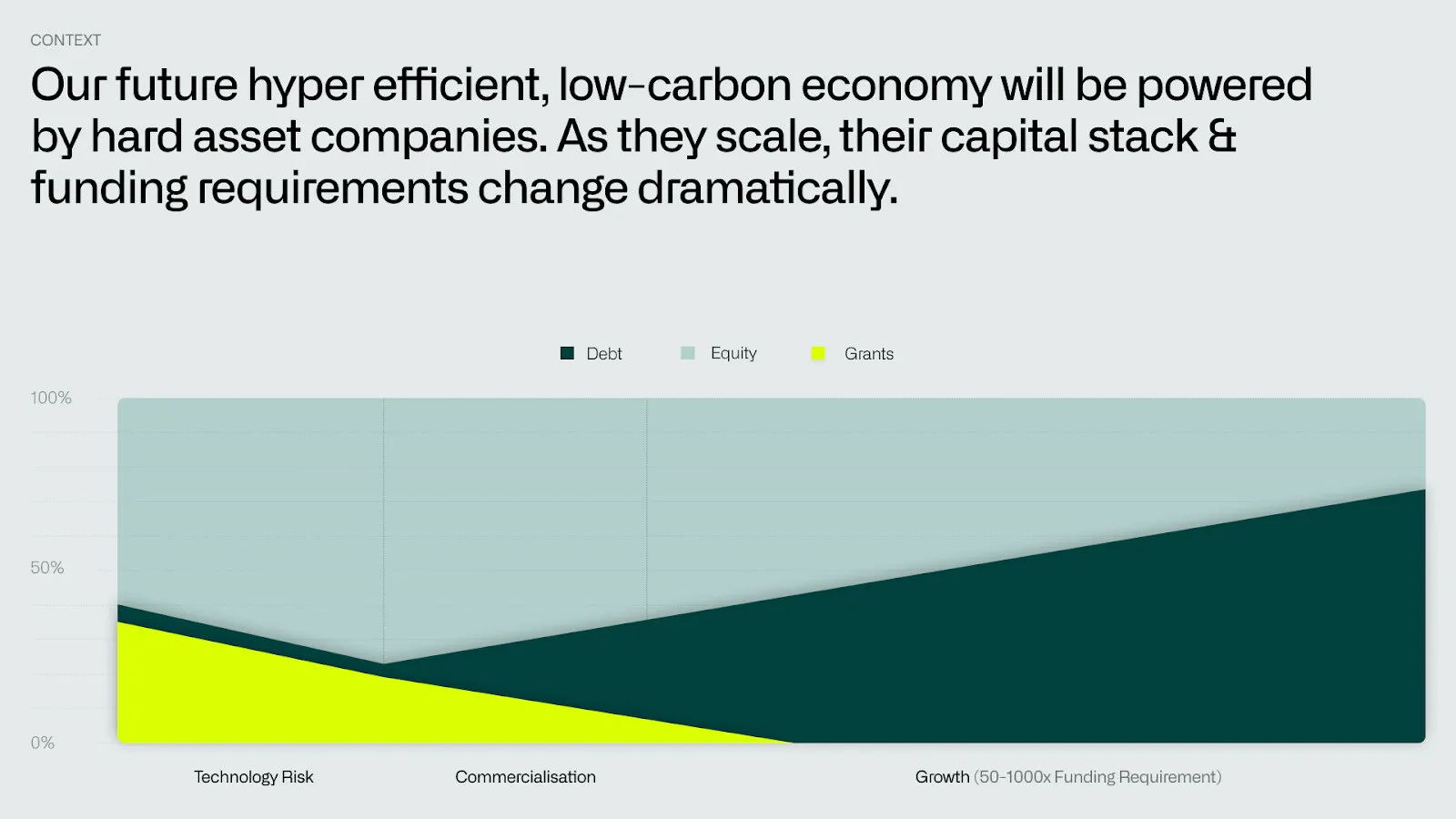
Hard asset startups typically begin in Act I: The Engineering Phase. Here, they raise equity to prove technical viability. VCs are comfortable here; they underwrite unlimited upside and accept high failure rates.
However, to reach scale, these companies must graduate to Act II: The Financial Engineering Phase. Here, relying just on venture capital becomes fatal. Using expensive equity to fund CapEx—buying forklifts, solar panels, or GPUs—is prohibitively dilutive. Instead, these companies need debt.
This is where the transmission breaks down. As Tangible co-founder Aishwarya Dahanukar noted in the 4 x 4 Virtual Salon, VCs and Lenders speak different languages—they are “Mars and Venus”.
- VCs ask: “How big can this get?” They want risk-taking and disruption.
- Lenders ask: “How safe is my principal?” They want downside protection, bankruptcy remoteness, and predictable cash flows.
This disconnect creates a “Valley of Death.” Many promising hard tech companies fail not because their technology doesn't work, but because they cannot translate their physical assets into the standardized financial products that institutional lenders require. They fail to transition from selling a vision to VCs to selling a reliable cash flow to credit funds.
Enter Tangible: The Capital Orchestrator
Tangible acts as the translation layer—a “system of intelligence”, as we like to invest in—that solves this coordination failure. They provide the infrastructure for Capital Orchestration.
We invested in Tangible because they enable startups to execute “Act II” by structuring, raising, and managing asset-backed financing (ABS). Their platform democratises the complex financial engineering that was previously available only to industrial giants like Tesla or SpaceX.
Tangible’s platform addresses three critical needs:
- Bankruptcy Remoteness: Tangible helps startups structure Special Purpose Vehicles (SPVs) that isolate the assets from the company’s corporate risk. This allows lenders to underwrite the asset (e.g., a battery or a robot) rather than the startup, significantly lowering the cost of capital.
- Standardisation: Credit markets love legibility. Tangible standardises the data, reporting, and legal structures of these deals, turning bespoke, messy startup assets into tradeable financial products.
- Transmission: By acting as a “digital trading house,” Tangible connects these packaged assets with the institutional debt markets—the pension funds and insurance companies that hold the long-term capital needed to fund the new industrial age.
Through Tangible, capital intensity stops being a bug and becomes a feature. As eloquently expressed by Tangible co-founder Will Godfrey together with Brett Bivens and Packy McCormick, if financed correctly through securitisation - or, as they put it, with the right finance stack - capital intensity isn’t bad and, in fact, can become a a competitive moat. It allows companies to deploy more assets with less equity dilution, effectively multiplying their capital efficiency
Fintech as Horizontal Infrastructure
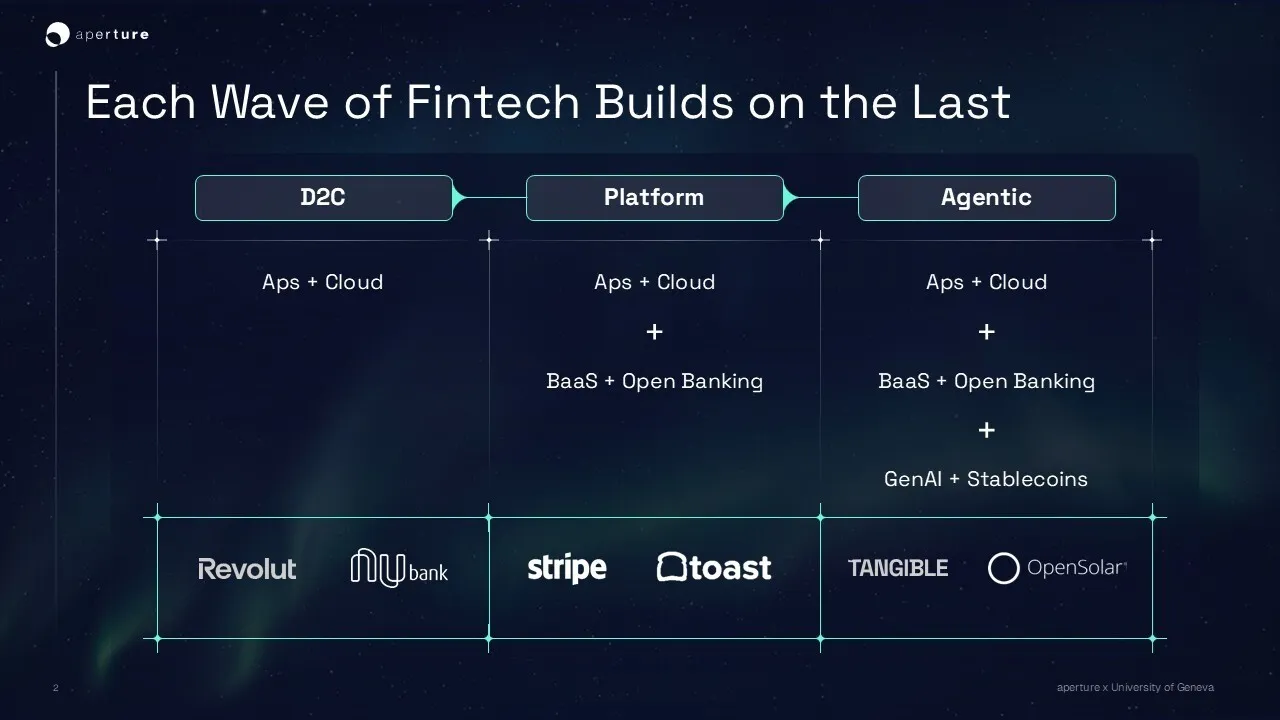
Our investment in Tangible also underscores Aperture’s broader thesis: Fintech is a horizontal market, not a vertical one.
For too long, fintech was viewed as a challenger to banks—a vertical silo. We believe the next wave of fintech is infrastructure that empowers the economy at large. Just as APIs abstracted away the complexity of payments for e-commerce, platforms like Tangible are abstracting away the complexity of debt financing for the new industrial economy.
This is particularly vital for Europe. We lack the mass of the US or China—we do not have a unified capital market or a massive population. To compete, we must achieve “scale without mass” by using technology to orchestrate resources more efficiently. Tangible is a prime example of this: a digital platform that allows smaller, innovative hardware companies to access the same capital efficiency as global industrial giants. And, In Europe’s case, we think a lot of this capital will come from both private debt funds and also corporate balance sheets, where there is significant firepower, especially relative to other major economies.
The GenAI Enabler
Finally, we believe the timing for Tangible is perfect because of the emergence of Generative AI.
Asset-backed lending is notoriously complex, involving phone-book-sized credit agreements, intricate waterfalls of payment priority, and constant monitoring of covenants. Historically, the high cost of managing this complexity made lending to smaller hard asset companies uneconomic—creating a €40 billion financing gap for SMEs in Europe alone.
Generative AI acts as a step-change in this equation. By deploying systems of intelligence capable of reading complex term sheets, automating compliance, and orchestrating workflows between borrowers and lenders, GenAI drastically reduces the transaction costs of these deals, as it will in other high cost-to-serve financial products like wealth management.
Tangible is building this intelligence into the core of their platform. They are not just a marketplace; they are an automated investment banker and servicer rolled into one, leveraging data to make the hard asset economy legible to the digital financial system.
The Next Horizon: Programmable Capital
Looking further ahead, we view our investment in Tangible as a foundational step toward a broader systemic reset of global finance: Tokenization.
While financial markets have been digital for decades, they remain fragmented across separate ledgers—brokers, custodians, and exchanges all maintaining their own records that require constant, costly reconciliation. This friction is particularly acute in private credit and hard assets, where liquidity is low and transaction costs are high.
Tokenization solves this by establishing a “single source of truth” on a shared ledger. But it offers more than just efficiency; it enables Programmable Capital.
In a tokenized future, the complex legal agreements and waterfalls of payment priority that Tangible currently helps structure can be encoded directly into software. Instead of relying on armies of trustees and administrators to manage cash flows from a fleet of batteries or a data centre, smart contracts can automate governance and execution. This allows for “atomic settlement,” where ownership transfer and payment happen simultaneously, drastically reducing counterparty risk.
Furthermore, tokenization collapses the rigid boundaries between asset classes. As we move toward this future, we envision a world where a hard asset financing facility could dynamically shift between debt and equity based on real-time revenue targets, or where a solar farm’s yield is unbundled from its capital appreciation to suit different investor profiles. This effectively democratizes complex financial engineering, making the $68 trillion infrastructure build-out accessible to a wider range of capital.
While Tangible is not building tokenization infrastructure today, they are doing the prerequisite work required to make it possible. You cannot tokenize chaos. By standardising data, legal structures, and reporting for hard assets, Tangible is making the industrial economy legible to the financial system. Once these assets are structured and standardized, placing them on-chain to unlock global liquidity is the logical evolution in Aperture’s roadmap for the asset class.
The Future is Tangible
The most successful companies of the next decade will be those that combine the world's best engineers with the world's best capital orchestrators.
In physical industries, we are running out of road for software-only models. To rebuild our industrial base, secure our energy future, and meet the demands of the AI economy (which itself requires massive physical infrastructure), we need to unlock the trillions of dollars sitting on corporate and institutional balance sheets.
Tangible is the key to that unlock. They are solving the transmission problem, ensuring that the capital required for the Hard Asset Supercycle finds its home. We are proud to back Aishwarya, Will, Seb and the team as they build the financial rails for the age of the New Industrials.
Subscribe to our newsletter
Join our newsletter to stay up to date on features and releases.
