0
min read
The Trust Layer
11 June 2026

Share
Aperture invests in Trustap to build the settlement infrastructure for the transactional Internet
Every significant commercial paradigm has required its own trust infrastructure. The hard part of commerce has never been the payment itself. Instead, it has been the moment before the payment — the moment when two strangers must decide whether to trust each other enough to transact.
Given our focus on financial services, we at Aperture have spent considerable time thinking about how trust gets engineered into commercial infrastructure. We have watched the internet evolve from a medium for browsing listings to a medium for completing transactions. And we believe that evolution is now entering a third phase — one in which AI agents, not humans, will be the primary actors in commerce. That phase will require a trust layer that does not yet exist at scale.
Fortunately, Trustap is building it.
The Classified Ad Problem
The first generation of online commerce was built on listings. Online marketplaces like Craigslist, OLX, Subito and DoneDeal created enormous value by aggregating supply and demand. But they remained, fundamentally, notice boards. A buyer would find a seller, and then the two would step off the marketplace to complete the transaction — by bank transfer, by cash, by hope.
The result was a persistent ‘mistrust discount.’ Sellers priced in the risk of non-payment. Buyers priced in the risk of fraud. Because of the discount, entire categories of goods remained stubbornly illiquid and difficult to trade: the friction of anonymous peer-to-peer exchange was simply too high. The marketplaces captured the discovery value but not the transaction value. They even bore reputational damage every time a deal went wrong.
A potential fix, from a marketplace perspective, has been to go properly transactional: to offer buyer protection, escrow, and verified fulfilment. But, as it turns out, this is harder than it sounds.
The In-House Trap
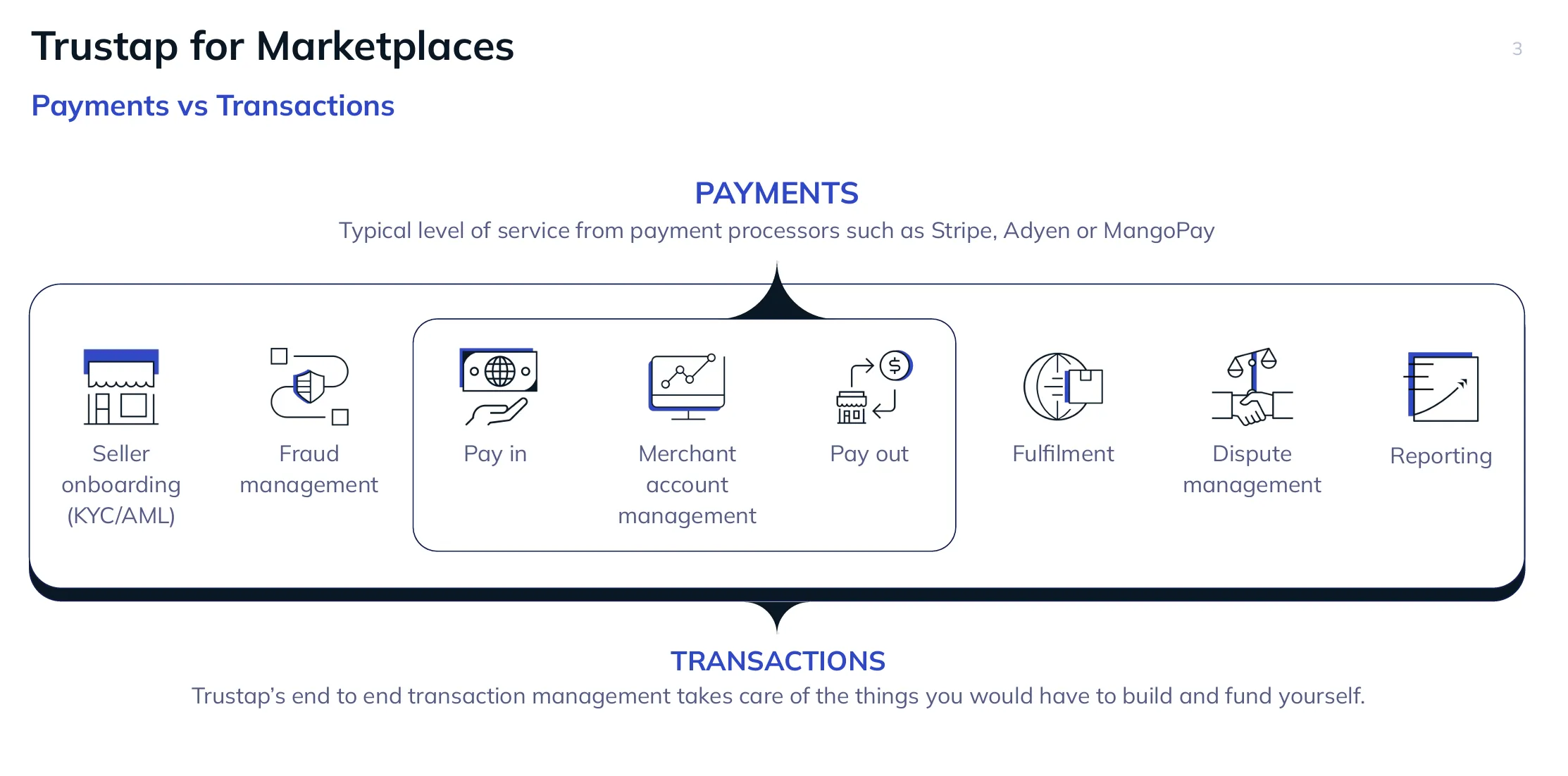
Becoming a transactional marketplace requires stitching together a complex set of capabilities: KYC and AML compliance, fraud detection, chargeback management, dispute resolution, and diligent customer support. Each of these is a specialized discipline in and of itself. Bundled together, they represent a significant operational and regulatory burden that most marketplaces are ill-equipped to carry.
The economics simply don’t work on a small scale. When OLX, one of the largest C2C platforms in the world, launched its in-house Pay and Ship solution in 2022, it ran at negative unit economics, with profitability taking a hit for several years. As for another marketplace, it required 25 internal staff to manage its transaction operations — a headcount that carried not just salary cost but compliance exposure, operational complexity, and a permanent drag on the core business. In most cases, the price of removing the mistrust discount simply proves unsustainable.
Why is it so hard? Simply because a single marketplace, however large, typically lacks the transaction volume to run a trust operation profitably. The fixed costs of compliance infrastructure, dispute handling, and fraud tooling are too high relative to the GMV of any one marketplace. Therefore, what is needed is a specialist operator that can absorb these costs across hundreds of marketplaces simultaneously — achieving the scale efficiencies that no single marketplace can reach alone.
This is the model that made Checkr the default infrastructure layer for background checks, unleashing scaling power for the on-demand economy across several sectors in the process. It is now the model Trustap is replicating for marketplace trust.
The Specialised Trust Operator
Trustap provides an end-to-end trust and transaction infrastructure that any marketplace can deploy via API. It handles KYC and AML, holds funds in escrow, handles shipping and fulfilment, manages disputes, and releases payment — all without the marketplace needing to build or staff any of this in-house.
The record speaks for itself. Trustap’s dispute rate is 0.19%, against an industry average close to 1% — 81% lower. Its win rate in disputes is 90%, against an industry norm of 50%. Just as with the Checkr precedents, these numbers reflect the compounding advantage of specialization: by handling disputes and fraud across a large and growing portfolio of marketplaces, Trustap accumulates pattern recognition and operational leverage that no single marketplace could replicate.
Then there is the impact on marketplace metrics. Student Seats, a ticketing marketplace, saw cart-to-paid conversions rise from 68% to 71.5% after integrating Trustap — contributing to an 87% revenue CAGR for the business.
When you remove the mistrust discount, something more significant than friction reduction happens. Economists call it the liquidity premium: the more readily an asset can be traded, the higher the price it commands. More sellers list because they trust they will be paid fairly. More buyers transact because they trust what they are getting. Volumes rise, quality improves as bad actors are screened out, and the marketplace captures transaction value it was previously leaving on the table. Trustap is, in this sense, a market-maker — not for a single asset class, but for the whole of peer-to-peer commerce.
.webp)
The Flywheel into Embedded Finance
Once a marketplace becomes transactional, something else happens: it starts generating data. Every completed transaction, every dispute, every fulfilment confirmation is a signal. Before Trustap, much of this information was lost in offline handshakes, invisible to marketplace operators. With Trustap, it becomes captured, structured, and available.
This proprietary data unlocks embedded financial services — products that can only be offered when a marketplace has genuine visibility into the behaviour of its buyers and sellers. Revenue-based lending, trade credit, insurance, and financing products all become possible once Trustap delivers and operates the underlying transaction layer.
The same logic applies here: transaction infrastructure, once built, compounds in value as the data it generates enables higher-margin financial products.
The Agentic Commerce Problem
So far, this is a story about making human commerce work better. But yet another important story is about what comes next.
We are moving toward a world in which AI agents act as autonomous commercial actors — booking travel, purchasing goods, negotiating contracts, and managing supply chains without direct human involvement at each step. Despite the widespread skepticism, this is not speculative. The workflows are already emerging in B2B automation and financial operations, and they will become progressively more agentic as the underlying models improve.
These agents, however, face a fundamental problem. The open web was built for human eyes. Its storefronts are graphical interfaces optimised for browsing, not APIs optimised for machine logic. An AI agent cannot manually negotiate a dispute, vet an anonymous seller, or navigate a checkout flow designed for a human with a credit card and a mouse.
More fundamentally, agent-to-agent commerce requires a neutral, programmable third party. When two AI agents transact — one representing a buyer, one representing a seller — there must be infrastructure that can hold funds, verify conditions, confirm fulfilment, and release payment without human oversight at every step. Without this, autonomous commerce cannot function.
Consider someone who bought a concert ticket and can no longer attend. They find a buyer online — a stranger. One of them has to go first: either the seller ships the ticket before being paid, or the buyer pays before receiving it. Neither is comfortable. The transaction either fails or proceeds on a wing and a prayer.
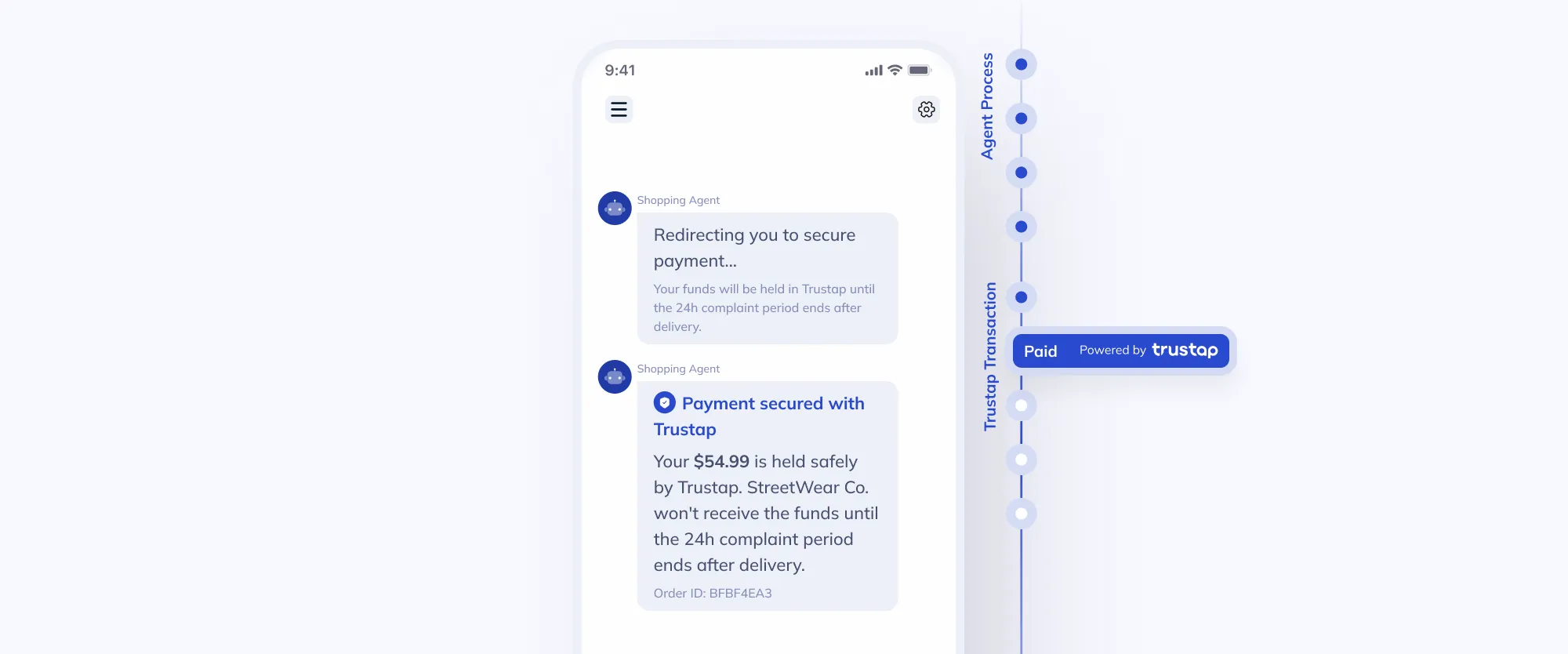
With Trustap, the buyer’s funds are held in escrow. The ticket is shipped. When the buyer signs for delivery, Trustap receives confirmation via API and releases payment to the seller. Both parties are protected throughout.
This workflow requires no modification to serve AI agents. The escrow logic, the API confirmation, the conditional release of funds — all of it is already programmable. As a result, as AI agents take on more of our commercial activity, Trustap’s infrastructure extends naturally to cover transactions in which neither party is human.
Trustap Index: Inventory for Machines
The second structural requirement for agentic commerce is structured data. AI agents cannot transact against listings that were written for human readers — unstructured titles, inconsistent descriptions, images without machine-readable attributes.
Trustap is addressing this through Trustap Index, a layer that aggregates inventory from partner marketplaces, e-commerce stores, and individual sellers, and translates it into structured, machine-readable data optimised for large language models. Index acts as a headless marketplace: it makes inventory from marketplaces discoverable and transactable by AI models such as ChatGPT, Gemini, and Claude — without those marketplaces needing to build separate AI integrations.
For partner marketplaces, the value proposition is straightforward: their inventory becomes visible to millions of AI buying agents that they cannot reach on their own. For AI agents, Index provides a single, reliable aggregation point for structured secondhand inventory across categories. Finally, for Trustap, it creates a powerful network effect — the more marketplaces that contribute inventory, the more useful Index becomes to AI agents, and the more AI agent volume flows back through Trustap’s settlement layer.
The final piece of this architecture is the MCP integration. Trustap is building a Model Context Protocol (MCP) server that will allow AI agents to interact with its marketplace infrastructure directly — creating listings, searching inventory, initiating escrow, and confirming transactions — through a standardized interface. This translates into interesting use cases: a user could photograph an item, have their AI agent upload it to the Trustap headless marketplace via MCP, and have it listed and transactable without ever creating an account on a traditional marketplace.

Fintech as Horizontal Infrastructure
Our investment in Trustap reflects a broader conviction at Aperture. The most valuable fintech companies of the next decade will be horizontal infrastructure layers that serve the whole economy rather than competing within a single vertical. Just as payment APIs abstracted away the complexity of card processing for e-commerce, Trustap abstracts away the complexity of trust for the transactional internet, allowing marketplaces to go transactional without hiring compliance teams or building dispute operations from scratch.
Europe has a particular need for this model, as no single market across the continent has the depth of the US or China. A platform that serves hundreds of marketplaces across multiple geographies can achieve continental scale through aggregation rather than size. Trustap already operates across Ireland, the UK, and Italy, with a growing presence in the US. Each new customer across these geographies is adding volume to a shared infrastructure that individual marketplaces could not justify building alone. The result is a network that gets harder to displace as it grows.
The trust layer also improves with use. Rather than limiting participation through upfront permission, Trustap allows buyers and sellers to transact freely and holds them accountable through data and accumulated reputation. Every dispute resolved, every fulfilment confirmed, every fraud signal detected feeds back into a system that makes the next transaction safer and cheaper than the last. This is why Trustap’s dispute rate — already 81% below the industry average — continues to fall as transaction volume grows.
Finally, for agent-to-agent commerce, the economics improve further still. AI agents transacting at machine speed across jurisdictions and currencies cannot absorb the latency and cost of the legacy correspondent banking system. As it’s starting to reflect on future expansion into emerging markets, Trustap is exploring stablecoin settlement as the natural settlement layer for this traffic — one that could reduce transaction and FX costs by more than 50% and enable instant cross-border payouts, making the unit economics of autonomous commerce viable at scale.
Why Now
Two forces are converging. Traditional classifieds and listing platforms are under pressure to go transactional or lose users to competitors that offer protection. That pressure has always existed in principle; what has changed is that buyers now expect it to be closed, and marketplaces that do not close it face measurable attrition.
At the same time, AI agents are arriving without any trust infrastructure to transact on. The models, the protocols, and the agent frameworks are being built now. The settlement and verification layer underneath them is not. Trustap is building that layer while generating real revenue from human commerce today.
Physical retail required the legal system and cash. E-commerce required SSL, card networks, and platform guarantees. The transactional internet — human and agentic — requires programmable, API-native trust at scale. We are proud to back Conor, Eoin, and the team as they build it.
Subscribe to our newsletter
Join our newsletter to stay up to date on features and releases.